December in Death Valley and the Mojave Desert

~ by Sumalee

We'd been thinking of returning to Death Valley for a while, and a break between gigs in December 2025 provided the opportunity.
This second trip to Death Valley trip would register two significant changes for us since our first foray into the lowest place on earth, 282 feet below sea level. We would be returning as a married couple and as practiced birders. In fact, I proposed to V at sunrise on a day we had embarked on the long drive into the park from Beatty, NV, at 4:00 am.
(She accepted, you will surmise.) This trip, we also would be adding a stop in the Mojave National Preserve further south. The Mojave Desert technically encompasses Death Valley, but they constitute very different landscapes and topographies. It would turn out to be a good plan.
We planned for three stops in campgrounds, two in DV and one in the Mojave. We developed "wish lists" of birds according to eBird sightings historical and current hot spots. This trip would surpass many others in terms of new species identifications: nine new species in less than twelve days to inscribe on our Life List.
Now, before continuing, I'd like to address the bewilderment that most people convey when informed of our birding plans in Death Valley. Death Valley is the "driest" national park, but it once abounded with oases of literal oases and sporadic ephemeral wetlands. It also lies along the Pacific Flyway and represents a substantial stop-over during spring and winter migrations. We would enjoy spotting some of these winter migrants.

Traces of Death Valley's moister history are easily found. In fact, Stovepipe Wells derives its name from the well created at a water source visible at ground level. This particular winter, a large area surrounding this historical marker remains moist, tenaciously holding on to water that cannot be entirely captured and diverted. Other areas identical to these substantial areas of clay and sand show the same mosaic of damp broken pottery. The tourist attraction Badwater Basin also holds on to water and is apparently spring fed. And since Death Valley mountains stretch to 11,000 feet above sea level, mountain springs do exist.
First stop: Furnace Creek and environs
new species: Vermilion Flycatcher, Verdin, Ruddy Ground Dove, Red-headed Woodpecker
It was such a pleasure to drive up to the National Parks booth to register and thank the staff for their service, so important for managing wilderness, preventing humans from trashing our national land and imposing on wildlife. The protracted federal shut-down had flattened their paychecks, but not their spirits!

This particular campground abuts on the main Death Valley visitor center. Adjacent to that is the embodiment of a deal with the devil, a shoddy compromise but better than none: a golf course shamelessly named "The Oasis" precisely for the actual historical topographical oasis that it supplanted and replaced. However, Audubon International has apparently "certified" the golf course, which contains small areas of restored marsh and avenues of palm date trees and tamarisk trees that attract birds. Birders, therefore, are permitted to ramble about at large, though cautioned against flying golf balls.
For this reason, the Oasis and its resort, Furnace Creek Ranch, is a fiery orange hotspot on eBird. Birds may not have the large natural oasis of the past, but they do have recycled waste water in a marshy environment and lots of sheltering trees. eBird users had reported spottings and posted documentary photos of birds as well as locations and these birds were sticking around for months! Our first day out, we spotted not just one verdin, but three. These beautiful little desert birds "in steep decline" due to development (All About Birds, Cornell U.) have brilliant yellow-chartreuse heads and a striking blood-red shoulder patch. These guys foraged in trees conveniently adjacent to the wooden viewing deck on the restored marsh.

Across one of the two main ponds, we spotted what looked like a small squat Say's Phoebe from afar, but we scrutinized the fella--more precisely, gal--to pieces because we already knew that a Vermilion Flycatcher had been reported. This female of this bird now "scarce" to the region bears a pale supercilium and white breast lacking in the Say's, so we knew it had to be a Vermilion.

The next day, our heads turned 90 degrees up to the sky, we searched the date palms for the red-headed woodpecker last reported in this spot. The individual was a juvenile, so his head would only show red mottling rather than complete red. Because he happened to be a very finicky woodpecker, flitting from palm to palm in order to find the perfect spot to store the dates that were nearly too big for his bill, we were able to see and follow him well. We ran into two older women birders who had driven in from Huntington Beach for a same day excursion to chase down the eBird reported birds for their life lists. One of the two was very competitive and all business, but she knew her stuff like an encyclopedia. We felt gratified that we could point out the woodpecker to them, and not the other way around, given their experience.

They would return the favor. Later, we ran into them again and they reported "a good look" at the Ruddy Ground Dove in a spot that we had already canvassed, futilely. We returned to the area and searched, again to no avail. Serendipitously, while I had to take time to manage a family problem, V. had time to walk around the area. She decided on an empirical tactic: canvass EVERY tree in the area. Unbeknownst to preoccupied S., V. squinted into every single tree top, searching for a shape relatively small for a dove that easily camouflages into shadows by its ruddy chestnut coloration. I saw V. across a green enthusiastically pointing up: she had spotted the dove after eight trees.

Our outings do not require a new bird species to be successful. We did set out to the beautifully rehabilitated Salt Creek site in search of the Sagebrush Sparrow, who remained elusive, but plenty of strappy American Pipits made their appearances. The creek itself was low despite the winter season, and a ranger back at the Furnace Creek visitor center related that a loon had gotten trapped in the creek, which was too low for it to have an adequate "runway" to fly off, but one of her colleagues had rescued it and successfully rehabilitated and released it (the goodness of these people: we looked at the ranger's video of the loon splashing about in a bathtub). V. pulled her usual not up but out by 5:00 am routine, so we greeted a watercolor sunrise over the creek. At least two different types of cranes or herons had left their footprints not only in the clay creek bed, but also along the newly restored boardwalk, like fingerpaint.

Second stop: Stovepipe Wells Village and environs
new species: Gambel's Quail, Woodhouse Scrub-Jay, Juniper Titmouse
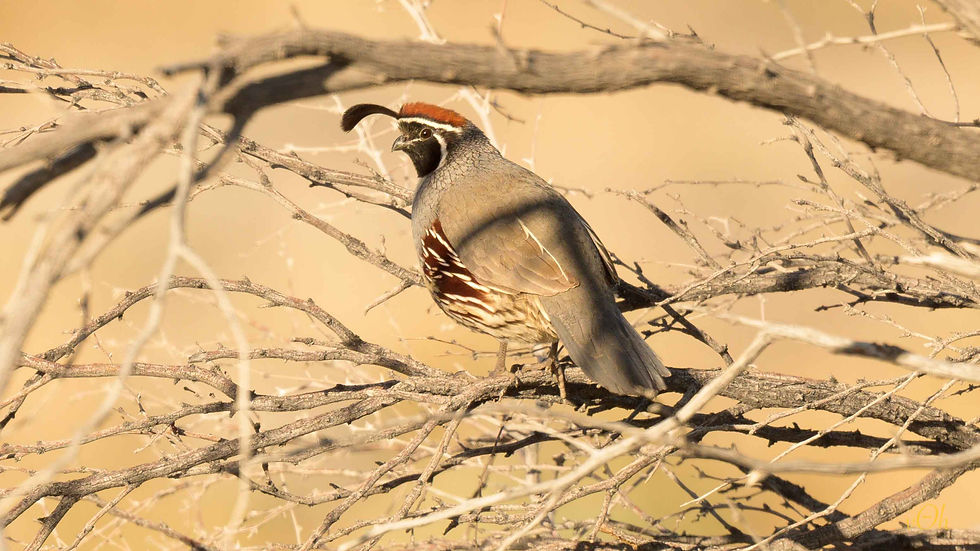
We traded Furnace Creek for a rather drab campground at Stovepipe Wells village, but this campground centrally located us to explore another region of Death Valley. We took a day trip out to Ash Meadows National Wildlife Refuge, since we cannot be less than 100 miles away from a NWR without succumbing to the compulsion to visit. Here, we saw specimens of the notorious endangered pupfish, these free to approach unlike their brethren by necessity protected behind iron caging down the road at Devil's Hole. We spotted what may have been a Brown-crested Flycatcher, but without a sound identification, we could not add it to our list. We fleetingly glimpsed the Greater Roadrunner, who we've only seen once in Arizona. Finally, crossing a road, we saw a covey of Gambel's Quail. Quail are so cheerful, the way they scoot around. These desert specialists have less chainmail than their California cousins, but the brighter orange-maroon of their cap and flanks more than make up for it.
Birding is fun because it's so unpredictable. Luck plays a large role in new species encounters. On one particularly lucky day, we headed up Emigrant Canyon road to visit the Wildrose Charcoal Kilns, which would place us at nearly 6,000 feet above sea level.

More interestingly, at that elevation, we enter into the pinyon-juniper woodland habitat. I think I've previously mentioned how pivotal--dare I employ the outdated phrase "paradigm shift"--Chaon and Campbell's Habitats of North America field guide has been to us in our thinking about birding, specifically, and the environment, generally. Understanding the habitat enables one to understand why certain wildlife appear there sometimes or all of the time. The guide has become nearly predictive of the species of birds we'll see in any given habitat.

And sure enough, two new species not on our radar and not on any recent eBird list graced us with their presence. We first spotted what, in the terms of a postcolonial theorist, was an "almost the same, but not quite" California Scrub-Jay. Our CSJ always strikes us as resembling Fu Manchu, but this bird scarcely had a white eyebrow, and he lacked the blue bib beneath the scruffy white beard. The whites were duller, overall. He looked different, but his call sounded like a CSJ so we used Merlin sound ID (a product of Cornell University Ornithology Lab) to verify, and it did verify the pair's calls as Woodhouse's Scrub-jay.

Right after that surprise lifer, we walked up a closed road a ways and spotted lots of flittings low in the junipers. Junco, yep. Junco, yep. Junco, yep. The widespread junco, darling that he is, was teasing us with the prospect of something different. Then, V. spotted an Oak Titmouse with a punkier crest. But the Oak Titmouse would be out of his area. The Juniper Titmouse, however, is a specialist of the pinyon-juniper woodland. In fact, Chaon and Campbell designate him as an "Indicator Species," that is, if you see him, you can pretty much bet your bottom dollar that you are located within a pinyon-juniper woodland. Merlin describes the Juniper Titmouse as "possibly the plainest bird in North America" but "undeniably cute with a large eye and plain face." Merlin is less redemptive about the Oak Titmouse, described merely as "completely nondescript." V. would beg to differ as she has photographed the Oak Titmouse many times, and we find both species as charming as any other little feathered poof-ball.

It had been a long while since we spotted a Townsend Solitaire; perhaps very early in our birding experience in central Oregon. One was perched atop a juniper and V. got a good shot. But just to emphasize how ridiculously predictive the habitat model can be, among the birds that Chaon and Campbell list as likely encounters in the pinyon-juniper woodland: Juniper Titmouse - check. Woodhouse's Scrub-jay - check. Townsend Solitaire - check. Western and Mountain Bluebirds - check check.
Third Spot: Mojave National Preserve
new species: Cactus Wren, Black-throated Sparrow
Our campground in the Mojave ranked amongst the most scenic we've found. It was also very birdy. The variety of cacti and yucca along with the rock formations and colors led my mother to ask when shown one of V.'s photos, "Is this landscaping?"

I had kept from V. that I had been sweating bullets since the beginning of the trip that our reserved site would be occupied by a lawless camper and a confrontation would ensue, since this campground has no host or ranger oversight. During the federal shutdown, I had inquired about the reservation, and the campground information line informed me that campers with reservations were reporting a grab-fest at the campground, with lawless campers occupying spots at their whim and refusing to move when paying campers arrived.
Thank goodness we took the risk: our spot was free. Death Valley is part of the Mojave Desert habitat, but they possess very different landscapes and terrain. Surrounded on three sides by breathtaking desert washes, buttes, caves, hole-pocked canyons, we had plenty to do in the campground area without having to drive to a destination.

Within the first few minutes of dropping the Roost from our truck Sanderling (we are nerdy and birdy), an old friend visited: the handsome Ladder-backed Woodpecker we last saw in southern Arizona. He darted from one yucca to another, methodically foraging the perimeter plants of the campground. We spotted him patrolling the plants on a daily basis.
Our first morning, we began birding by hitting the "moderate" (AllTrails), i.e. intimidating (yours truly), trail which commenced at the north end of the campground. Of course, after an hour and a half, we realized that we hadn't gotten past 1/2 mile because the we couldn't stop stopping. Birds galore in rock crevices, on prickly pear and barrrel cacti and buckhorn cholla, in flocks on rabbitbrush and cheesebush silhouetted against a coral-hued landscape and blue skies: V. had difficulty choosing between her zoom and panoramic lenses, and even more difficulty switching between them.

Many new species require perseverance and a lot of squinting and blinking to spot for the first time: not the Black-throated Sparrow.
These guys boldly flew in front of us, perched, and posed, their velvety-black throats and sharp whites making them a handsome species.
Our previous sightings of the rock wren have been hard won, but here, we reported six individuals to eBird but most likely spotted eight or nine.
We began to be greedy and ungrateful: yes, so wonderful to see all of these rock wrens since it's been so long since the last time, but oh, if only one of them were a cactus wren!

We were wanting in patience and humility, and soon enough, one and then another cactus wren then its mate flitted in and out of view. Although larger than the rock wren,

the cactus wren's glamorous plumage--they've got spots, stripes, bars, and several colors!--actually camouflage it very well. This variegated feathering usefully mimics the stark shadows and glare of the desert's canyon and flora. Hiding in plain view, quite literally. We spent time on that first half-mile, enjoying the morning in what according to our definition is a paradise on earth.
We stayed two more days before heading back, the Ladder-backed appearing while we were packing up to say goodbye. We don't consider this a goodbye, however, and V. is already at the table drafting her scheme for us to return to the Mojave sometime in the spring to witness the habitat's principal migration and bloom. Because of the record levels of precipitation this past fall, which unfortunately may be attributed to climate change, a spring riot of color and sound is expected.


This was a very informative article with practical landscaping ideas. Choosing experienced hardscape construction professionals is one of the best ways to create durable outdoor spaces that improve both functionality and curb appeal while adding lasting value to any property.
December is actually one of the best times to experience Death Valley and the Mojave Desert. The temperatures are far more comfortable compared to the extreme summer heat, which makes exploring the landscapes, hiking, and long scenic drives much more enjoyable. The winter light in the desert also creates incredible colors at sunrise and sunset, especially around the dunes, salt flats, and rocky valleys.
What makes those areas special is the contrast between openness and detail — at first the desert can seem empty, but the more time you spend there, the more layers you notice in the terrain, wildlife, and atmosphere.
That idea of gradually discovering layers reminds me a bit of how well-structured digital platforms work too. For…