Return to Green Creek Wildlife Area and Lundy Canyon, California

~ By Vicky ~

Over the recent years I've noticed the way I travel has changed. In years past the priority had been to see new places, and rarely did I want to go back to a place I have been to, knowing there was so much more to see. Even with hiking, I'd rather hike a new trail than go back to one I've already done, no matter how good it was. There are campsites I've been to and hikes I've trodded that I couldn't remember how to get back to. When I back-packed through Europe and Southeast Asia in my twenties, while I can remember some of the small towns and villages I passed through, I'd be hard pressed to locate them on a map or even retrace that travel itinerary. The goal then, and I suppose the travel high, was to always experience the unexperienced.
When S. and I were tent campers I'd find us new places for dispersed camping or primitive campgrounds stays. It's as if going back to a place were to admit defeat, and that I lost my touch keeping it fresh and therefore stimulating. And when we seriously got into birding and started planning trips around National Wildlife Refuges and Important Bird/Biodiversity Areas (IBAs), I still tried to find new ones to go to rather than make return trips. Then something changed. There began a longing to return and even retrace a tried path. My imagination started asking me,"what else is here?", "what if you missed something?", and the one that really got me was, "did you appreciate it enough?"
That off the beaten path feel was getting harder and harder to assuage as more distinct places were being highlighted and their existence amplified across the internet. For the past decade technology had become a necessity in planning our trips. I can't even begin to understand how I went anywhere prior to owning a smartphone with readily available internet versus relying on internet cafés (how did I even find them in a foreign city?) and a prepaid phone card. But somehow I made the buses, trains, planes, etc. to get around Europe, Eastern Europe, and Southeast Asia, managed to find the trailheads and not get lost on hikes, made the drive across the United States west coast to east coast, than back again, and in general traveled safe and sound to all the places I explored pre-smartphone years.
Now a days, going back to a place we've been to means we're familiar enough of the place that I don't have to spend as much time Google Mapping the area, or checking trails on AllTrails, or searching the top ten restaurants. It's like traveling the way I was used to, by having a general idea of where we're going, getting there, and finding out what's around once we got there.
There are a few tried and true places that we've returned to because the familiar means less time spent in pre-investigative Google searches. We could focus on just being there, and if something new popped up, as was bound to happen, we took that with the familiar. The wildlife refuges of Klamath Basin and Malheur, Oregon were two such places. Priest Hole campground was another. At the time of revisiting those places I think we were asking ourselves "what more can we see and do here?"
It was a recent trip in May, 2026 to Green Creek Wildlife Area, California that begged the question "Did we appreciate it enough?" We had been here twice before. The first time on a day drive with S's. mom in October, 2020, as part of a week long trip to show her Mono Lake and the Eastern Sierras. The second time was with the Roost, our truck camper, in June, 2025, to fulfill the desire to camp in the area after having seen so many wonderful dispersed campsites situated along the creek. This, our third trip, we simply wanted to bask in the high desert and be amongst the confluence of shrubby desert sage bushes, juniper trees, aspen groves, and riparian zones that make this a distinct landscape.

One of the many campsite views along Green Creek
And of course we wanted to see birds. But we were realistic in our expectations that late spring at high elevation was not a prolific time to bird. Instead, we wanted to see again the birds that were iconic to us of such habitats: the Mountain Chickadees with their bold Eighties-esque lightning bolt head striping; Clark's Nutcracker with their Harley-Davidson leather black wings; gorgeous Mountain Bluebird. And to refamiliarize ourselves with the likes of Green-tailed Towhee, Vesper, and Brewer's sparrow. We gained a new appreciation for the Fox sparrow, whom we did not realize came so high up in elevation, and who look so much more handsome up here with their dapper-gray head and back plumage worn like cloaks and offset by rufous wings and tails - coloration that we've never noticed when seeing them in low lands.

Fox Sparrow with distinct chevron chest spots

Fox Sparrow with dapper gray cloak and rufous tail and wingtips
As with all our dispersed camping (or boondyking in our queered RV parlance) experiences, where primitive sites are first-come, first-served, I got the usual anxiety-thrills as we neared the Green Creek Wildlife Area. Driving low and slow on gravel road not knowing whether we'll snag our perfect site foments jittery anticipation in my stomach. For this trip we wanted a particular site that had in the immediate vicinity a large meadow, a mix of aspen, pine and juniper groves, and the namesake creek with its green riparian splendor, all bookended on one side by a sage-brushed covered ridge. While dodging pot holes and minding dips, I silently prayed to any god that would listen to please, please let the site be there for us. The feeling of rolling ever so slowly up to a good site looking for signs of occupation is maddening; the feeling of seeing the site free and clear, pure elation - the jack-pot of primitive camping.

Coveted boondyking site along Green Creek.
As it was May, the most notable difference of this trip to our prior two visits was the higher water level and faster flow of the namesake creek. In turn, because of the snowmelt and cooler temperatures, the surrounding vegetation was rather lush. We were still too early for the wildflowers that typically bloom at high elevations around June-July, but we were glad to mostly miss the snow. I say mostly, because we had to turn around earlier than expected on the stunning Lundy Canyon trail due to icy snow pack covering the trail once we hit an elevation of 8,700 feet.

Ridge nearby our campsite that became our early morning birding spot
We were only at Green Creek for five days and in that time posted nine lists to E-bird. Because we were near a meadow, the ridge, and a riparian area, we were able to go early morning birding right outside our back door to explore the ridge and sage bushes, come back to the camper to rest, and then walk back out to explore the meadow and riparian area. The scrubby sage-brush land was a pleasing challenge to bird in. We could hear bird calls concentrated in distant areas, but look as we might, didn't see any movement. S. recommended that we walk up the gentler slope of the ridge, find a spot that had a good boulder to sit on, and just sit, wait, and look. This strategy worked perfectly. Perhaps it was the openness of the terrain, but while walking the birds just didn't want to be seen. It was while sitting in one spot that they revealed themselves by flying low along the chaparral.

S. stilled in the landscape.
Surprisingly, it was the Green-tailed Towhees that made themselves prominently known with their clear whistled songs as they perched on nearby Juniper trees to call out. Their larger size, distinct shape and coloration added to their prominent stature.
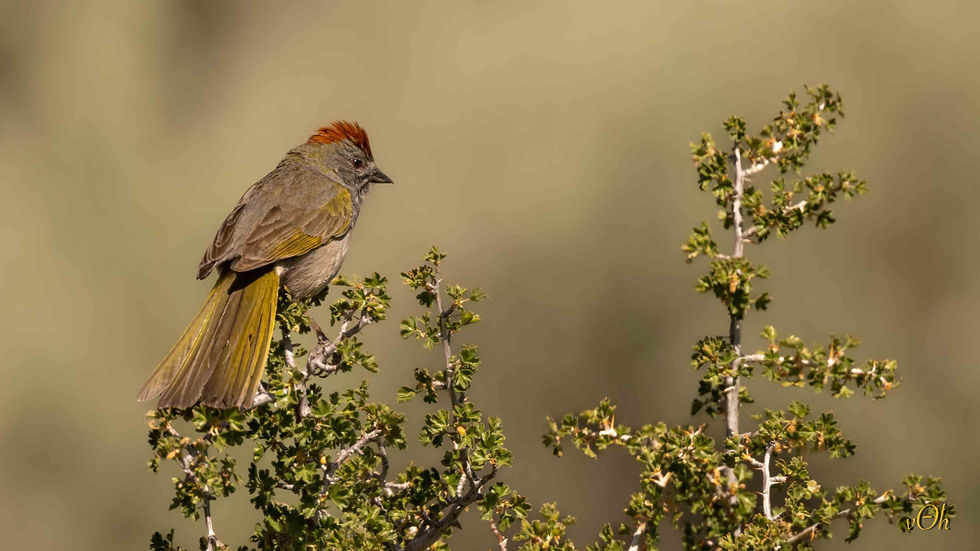
Green-tailed Towhee
The Brewer's Sparrow made a hearty attempt to come in second place for conspicuousness with their all out buzzy cries told from the treetops.

Brewer's Sparrow
The walk was short and could be from one and a quarter mile to two and a half miles depending on if we went to the creek. But in this short distance we walked through aspen groves and spotted Western Warbling Vireos, Mountain Chickadees, Stellar's Jays, Western Tanagers, a nesting American Robin. A pine grove near the creek had Mountain Bluebirds, Gray and Dusky Flycatchers, Tree swallows, and Red-breasted Sapsuckers. And the willows along the creek had Northern Yellow Warblers, Orange-crowned Warblers, and Wilson's Warbler.
This trip was one of the few that wasn't all rainbows and sunshine. As mentioned, we had camped at Green Creek the year before, and at that time was unable to hike the Green Creek trail to one of the subalpine lakes. Juniper, our beloved husky mix with an extremely sensitive stomach, had snatched a few sips from the brackish water of nearby Dynamo pond, and within twelve hours had a serious case of diarrhea that lasted days. This time we were on to her and didn't let her near the pond during a morning outing there. However, despite all our care she of the unbelievably ill-timed gastrointestinal problems proceeded to have the worst case of diarrhea yet (we believe from an inch of old standing water left in her water bowl in the hot camper. I foolishly wasn't thinking and the morning of leaving for this trip just filled the bowl with more water and let her drink it). Her diarrhea hit our first camp night so we were prevented again from doing the hike and even had to go to the only nearby emergency vet in Carson City, a cool eighty miles away. We spent that day on the drive, stopping every one and a half hours to let Juniper have a blow out on the side of the road. She did manage a blow out in the truck cab all over her dog bed, a first for her. She also vomited up her first dose of metronidazole, and then proceeded to be suspicious of any food or treat given to her, so giving her the horse pill of an antibiotic became a twice daily struggle. But as far as travel tragedies are concerned, we'd take her dog diarrhea over catastrophic crashes or injury any day.
There would be two silver lining events to Juniper's diarrhea. Prior to taking her to the vet we hoped her bowels would resolve themselves, but we couldn't leave her in the camper and we didn't want to be stuck all day at camp either. So we leashed her up and brought her on an early morning bird walk where we explored the meadow and the creek. After the walk I wanted to give her more time to go bathroom so took her on a circuitous way back to the camper, when lo and behold, we saw a male Sooty Grouse in full courtship display up in a pine tree! A female grouse in an adjacent pine tree was the end game for all his efforts. We've accidentally flushed out grouse before but this was our first good looks at the courtship. We would hear the male's courtship hoots over the next several days and nights. Poor guy never let up, and we feared he would die of exhaustion in his non-stop effort to attract and mate with as many females as possible.

Near perfect camouflage of a Female Sooty Grouse's mottled plumage in pine tree
Male Sooty Grouse courtship behavior
The day after her vet visit and on antibiotics, Juniper's diarrhea was getting better, but we still weren't sure we could leaver her for several hours without a potty break, so we postponed the Green Creek hike another day and opted for birding early in our meadow-ridge. The morning was full sun and by the time we got back to the camper around noon it had warmed to fifty-eight degrees. We lunched and I took a cat nap, with the cats of course. Sumalee read. The plan was to go back out to walk the short but steep Green Creek Road trail to the site of the historic hydroelectric plant. When I woke around two o'clock I looked out the window and noticed it was completely overcast. Not a big deal, so I casually looked at our outdoor temp sensor and saw it read thirty-two degrees! Incredulous, I asked Sumalee if she thought it was really thirty-two degrees outside, and so she stepped out to check. Just opening the door a blast of chilled air entered, and then I spotted small white flecks out the window - snow. We had no cell reception at our spot, so we hopped into the truck and drove several miles down the road to the only spot of cell reception to check the weather forecast. We weren't going crazy. The temperature was slated to drop into the low twenties overnight. In just the thirty minutes it took for us to drive out and back the temperature already dropped down to the high twenties. At almost 7,500 feet of elevation, we were hit by a sudden mountain storm. If it weren't for Juniper's diarrhea we would have done the hike that went up to 9,000 feet of elevation and most likely been caught out there in this sudden freezing storm!
The storm abated by the next morning leaving behind a cold but bright sunny day. S. and I were able to do the six and three quarter mile Green Creek trail to Green Lake. It was a stunning hike along the cold and fast flowing creek and beautiful pine forest in which we saw a good smattering of small birds. The subalpine lake itself was picturesque with the mountainous backdrop and we had our lunch lakeside and all to ourselves. The hike was worth the wait.

Green Lake with view of Gabbro Peak
We managed to boondyke at Green Creek for five days, the longest stretch for us with our limitation being determined by the black tank. So on Tuesday we did our last early morning birding in our beloved ridge-meadow, and then headed to the RV travel stop worthy Mobile gas station in Lee Vining to empty tanks, fill fresh water, and restock beer. Then it was off to Lundy Canyon Campground!

Nicely settled into our site at Lundy Canyon Campground
Lundy Canyon Campground is a first-come-first-served with a nightly fee of sixteen dollars. There are thirty-six sites, each of which have a picnic table, fire ring, and a bear box. Otherwise there are three pit toilets and dumpsters situated throughout the grounds. Our hopes were on getting site number five which we stayed at last year, but alas that was taken. As luck would have it, we snagged a larger and more secluded site, number twenty-nine. Even more fortuitous, when we both stepped out of the truck to survey the site, a Cassin's Finch flew to a conspicuous branch, looked down at us and gave a couple of calls before flying off. That was a lifer spotting! We saw this same finch with his mate on our last morning. It had rained the night before and the sparse ground cover sprang back to life giving the finch a good breakfast meal. I was lucky enough to get a photo of the male front lit by warm morning light and surrounded by the delicate pink and green hues of the ground plant, perfect compliments to his gorgeous pink plumage.

Cassin's Finch foraging on weedy ground cover
Our wanderings while in the Mono Lake basin included Mono Lake County Park to see the Tufas, but the boardwalk to the Tufa viewing platform was closed, so we gladly just birded with highlights being Black-headed Grosbeak, a pair of Bullock's Orioles, and good looks at the plumage of a Violet-green swallow.

Violet-Green Swallow shows off gorgeous plumage
From there we drove the gravel roads to Black Point trailhead, a hike we had to abandon on a previous visit due to poor trail signage. This time we were determined to see Black Point's famed slot canyon fissure. It was on the drive to Black Point that we got our second surprise lifer, the Sagebrush Sparrow, finally! We had high hopes of seeing this species while on a trip to Death Valley. So of course we never saw it then. As birding is 99.9% luck, the coveted spotting would happen when I chanced to pull over to glass a random bird shape atop a random sage bush.

Sagebrush Sparrow
Though there is a parking lot and trail head at Black Point, there is no actual marked trail. A single wooden sign with an arrow pointing ambiguously at the upper right corner of the sign is all there is. Last time we walked along the black sand beach but turned around after a futile quarter mile. This time, I looked up the ridge and decided straight up is the way to go. At just over a mile to the fissure, the hike was a punishing slog up loose black volcanic sand on a hot sunny day. We slalomed the small sagebrushes pausing only to spot the occasional Brewer's Sparrow, and to pick the straightest line towards the putty colored pumice of the hardened lava bed at the top.
The slot canyon was impressive and worth seeing, but only worth hiking once for us. Even promises of Sagebrush Sparrow and Gray Flycatcher sightings couldn't tempt us back.

Black Point's slot canyon fissure
The next day we woke for sunrise and took Juniper for an easy bird walk along Lundy Dam. Flashes of yellow shot through the foliage. MacGillivray's warbler, Northern Yellow Warbler, and Orange-crowned warbler would be our yellow heroes of the day.

MacGillivray's Warbler
With Juniper happy from her walk, we geared up and drove the lovely way to Lundy Canyon Trailhead. The drive alone is a treat as it gains elevation quickly and winds you past still but clear beaver ponds backdropped by snowcapped mountains.

Beaver pond
The hike is one of my all time favorites. The trail head sits at about 8,000 feet of elevation and gains another 1,000 feet to the base of Lundy Pass. At only 5 miles out and back it packs in so many waterfalls, pristine creeks, a beaver pond, a creek crossing, and valley views to make one's head literally spin at the thousand sights worth seeing. The namesake waterfall can be seen up close or perched from a picture-perfect boulder engorgement, and the creek upstream is fully interactive as it splits and meanders before you through the small valley gorge before becoming the waterfall. The trail goes forth matter of factly through the gorge surrounded on three sides by snow capped mountain ranges. Turning to look back gives expansive valley views. Silvery slivers of distant snow-melt waterfalls can be seen almost every step of the way as the gorge opens up. There's a second torrential waterfall that one can get up close to, that made for a good lunch spot. We had to end the hike just a half mile from the end due to hard pack snow obliterating the trail. But we had gone to the base of Lundy Pass the year before, so while I was disappointed not to see the last of the waterfalls at the top again, the entire hike is so full of luscious landscapes that one could turn around at any point and be satisfied.

Lundy Waterfall viewed from the boulder platform
We ended this trip feeling like we did our best to appreciate the land and life we came upon. I'd be lying if I said we accomplished a pure sense of appreciation without deep feelings of wistfulness. For S. and I, nature is both an eternal truth and a sublime gift whose wrappings we open and open and open ever time we go outdoors. And nature is the one gift-giver we hope never to take for granted.


Comments